%20--%3e%3csvg%20version='1.1'%20id='Ebene_1'%20xmlns='http://www.w3.org/2000/svg'%20xmlns:xlink='http://www.w3.org/1999/xlink'%20x='0px'%20y='0px'%20viewBox='0%200%201065%20225'%20style='enable-background:new%200%200%201065%20225;'%20xml:space='preserve'%3e%3cstyle%20type='text/css'%3e%20.st0{fill:url(%23SVGID_1_);}%20.st1{fill:%23606060;}%20.st2{fill:url(%23SVGID_2_);}%20.st3{fill:%2358B8C5;}%20.st4{fill:%2380BC49;}%20.st5{fill:%23FFFFFF;}%20.st6{fill:url(%23SVGID_3_);}%20.st7{fill:url(%23SVGID_4_);}%20.st8{fill:url(%23SVGID_5_);}%20.st9{fill:url(%23SVGID_6_);}%20.st10{fill:url(%23SVGID_7_);}%20.st11{fill:url(%23SVGID_8_);}%20.st12{fill:url(%23SVGID_9_);}%20.st13{fill:url(%23SVGID_10_);}%20.st14{fill:url(%23SVGID_11_);}%20%3c/style%3e%3cg%3e%3cpath%20class='st3'%20d='M216.6,222.6c-22.5,0-44.3-5.2-51-6.9c-5.1-1.3-8.2-6.5-6.9-11.7c1.3-5.1,6.6-8.2,11.7-6.9%20c25.1,6.5,67.6,11.1,81.4-3.2c6.4-6.5,9.4-17.2,9-32c-0.6-24.1-0.7-48.9-0.4-75.7l0-0.5c0.7-9.9-3.2-22.5-16.5-25.1l-0.6-0.2%20c-8.8-2.4-18.6-2.6-27.1-2.6c-9.1,0.3-32.8,1-35.3-27.6c-1.5-6-4.1-8.8-14-8.8H142c0,0,0,0-0.1,0l-27.1,0%20c-10.8-0.2-11.4,2.2-13.8,11c-2.1,7.5-4.9,17.7-16.7,23L83.4,56l-0.9,0.2c-7.2,1.7-14.2,1.7-21,1.8c-6.1,0.1-12,0.1-17.2,1.4%20l-0.7,0.2l-0.7,0.1c-19.3,1.6-22.6,17-22.1,29.6l0,0.2c0.6,25.3,0.6,50.7,0.6,72.6c0,29,10.9,36.1,20.4,39c6.5,2,14.1,1.8,21.4,1.7%20c15.5-0.3,31.6-0.6,46.6-4.9c24.5-7,71.3-38.5,86.1-61.4c10.3-21.8,3-36.3-6.4-42c-10.5-6.4-27.3-4.6-41.1,13.9l-7.5,10.1l-7.7-10%20C122.6,94.6,110,88.4,98.5,91.4c-9,2.3-15.6,9.9-17.2,20c-3.1,19,11.6,40.9,39.3,58.5c4.5,2.8,5.8,8.7,2.9,13.2%20c-2.8,4.5-8.7,5.8-13.2,2.9c-49.4-31.5-50-64.8-47.9-77.7C65.3,90.6,77.3,77,93.8,72.8c15.9-4.1,32.9,1.6,46.9,15.2%20c19.7-19.3,43.4-19.3,58.7-10c17.7,10.7,28.7,35.7,13.5,67.2l-0.5,0.9c-17.2,27.3-68.8,61.9-97.4,70.1c-17.3,4.9-35.4,5.3-51.4,5.6%20c-8.4,0.2-17.9,0.4-27.4-2.5c-22.5-6.9-34-26.2-33.9-57.3c0-21.7,0-47-0.6-72C0.4,61.9,15.3,43,40.5,40.6%20c7.1-1.6,14.1-1.7,20.8-1.7c5.6-0.1,10.9-0.1,15.8-1.1c2.7-1.6,3.7-4.3,5.4-10.3c2.6-9.5,6.9-25.3,32.4-25l51.9,0%20c18.2,0,29.2,8.2,32.8,24.3l0.2,0.7l0.1,0.7c0.6,8.5,2,11.2,15.8,10.7l0.3,0c9.7,0,21,0.2,32.1,3.1c20.4,4.2,33.1,22.2,31.6,44.9%20c-0.4,26.4-0.3,50.8,0.4,74.6c0.5,20.2-4.3,35.6-14.5,45.8C254,219.1,235.1,222.6,216.6,222.6z%20M141.2,34.1%20c-8.5,0-15.4,6.9-15.4,15.4S132.7,65,141.2,65c8.5,0,15.4-6.9,15.4-15.4S149.7,34.1,141.2,34.1z'/%3e%3cg%3e%3cpath%20class='st1'%20d='M387.2,200.5V59.1h21.1v141.4H387.2z'/%3e%3cpath%20class='st1'%20d='M510.4,59.1h30.3l44.8,92.9h-2l44.8-92.9h29.3v141.4h-21.3V82.3h3.4l-48.4,101.5h-13.9L529.4,82.8h2.1v117.7%20h-21.1V59.1z'/%3e%3cpath%20class='st1'%20d='M759.8,200.5V59.1h21.1v141.4H759.8z'/%3e%3cpath%20class='st1'%20d='M868.8,193.9v-21.4c5.5,3.4,11,6,16.4,7.7c5.4,1.7,10.6,2.6,15.5,2.6c7.1,0,12.2-2.1,15.4-6.3%20c3.1-4.2,4.7-10.3,4.7-18.3V59.1H942v99.1c0,10.7-1.6,19.4-4.9,26c-3.3,6.6-7.9,11.5-13.9,14.5c-6,3.1-12.9,4.6-20.8,4.6%20c-6.2,0-12.1-0.9-17.6-2.7C879.1,198.9,873.8,196.7,868.8,193.9z'/%3e%3cpath%20class='st1'%20d='M1042.3,200.5V59.1h21.1v141.4H1042.3z'/%3e%3c/g%3e%3c/g%3e%3c/svg%3e)
At nearly every other wedding today, there's a little card with a QR code somewhere. Scan, upload a photo, done. Sounds convenient. And it is, at least for that first moment. But anyone hosting an event who really wants to offer guests a private online gallery should take a closer look at what actually happens behind that little black-and-white square.
At imiji, we've been working on exactly this question since 2016: how do you get people to share their most beautiful moments without turning it into a security risk? And the answer simply isn't the QR code alone.
The QR code at the wedding table: convenient, but open to anyone
A simple QR code usually leads to a link that lets people upload and view photos without anyone having to sign in. That's exactly what makes it so popular, and exactly what makes it a problem. Events and weddings almost always take place at public venues, in hotels, restaurants, barns, or gardens. Anyone who sees that code lying on a table or takes a photo of it can get at the pictures. That applies just as much to cleaning staff the next morning as to guests at another party in the next room, or to people who simply happened to walk by.
You really don't want to put your guests through that. And you can tell from their behavior: when it isn't clear exactly who has access, many people would rather not upload anything at all, or pictures turn up that you'd really rather not see in your gallery.
The same path since 2016: why registration has proven itself for us
This discussion isn't a new reaction to a trend for us, it's actually as old as imiji itself. Back in 2016, when hardly anyone was thinking about QR codes at weddings, we were among the first platforms to tackle this exact issue. And back then we deliberately decided against open access.
That decision has proven itself. In all these years, there hasn't been a single case of someone gaining unauthorized access to an album through us. With Magic Link, we've now additionally found the middle ground that didn't exist before: the convenience of a simple link, combined with the security of a real account behind the scenes.
Maybe it also helps that we come from photography ourselves. We're very aware of the impact images can have, and the fears and hopes attached to them. A real photo can touch people, but it can just as easily hurt them if it ends up in the wrong hands or surfaces at the wrong moment. That awareness is behind every decision we make at imiji around access and visibility.
Upload wedding photos for guests without turning it into an open book
imiji relies on two access paths, and both end with a real account. The classic way is full registration, as you know it from countless other platforms. The second, much faster way is the Magic Link. An account is automatically created in the background the moment someone enters their email address. Anyone who later wants a full account with their own password simply uses the "forgot password" function and sets one themselves. A quick guest access turns into a permanent account along the way.
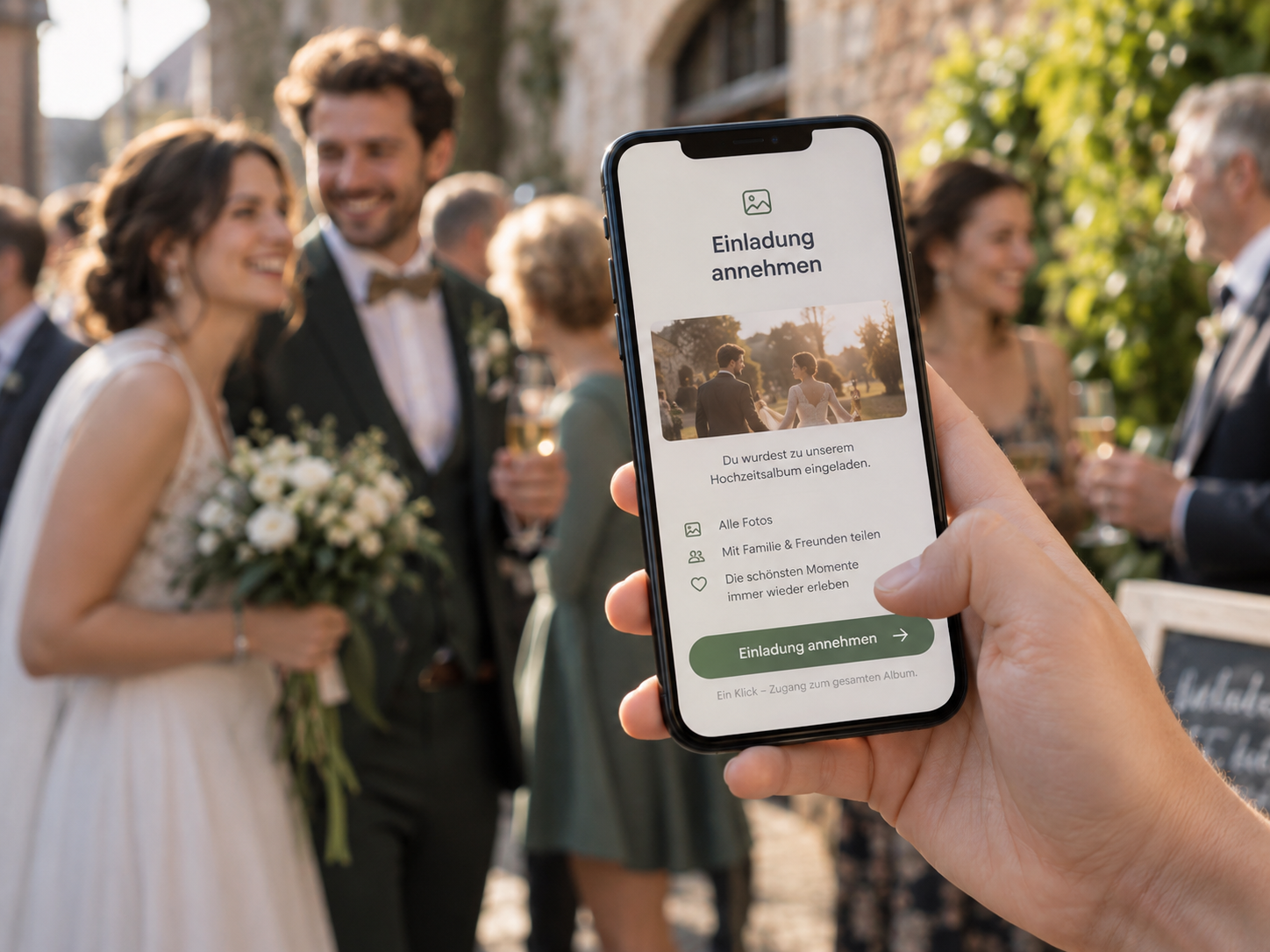
The whole thing becomes really practical once you install imiji as a web app on your smartphone's home screen or on your computer. You stay permanently logged in and don't have to sign in again on every visit. If you're invited to another album, no matter whether the link was sent via QR code, link, WhatsApp, Signal, or another messenger, one click on "accept invitation" is enough. The album lands directly in your own gallery.
Private wedding gallery: more than just a single event
Most people, when they think of photo sharing, think first of the one wedding or the one party. But imiji doesn't want to stop there. The goal is an online wedding gallery that doesn't end with the last dance, but becomes the starting point for many more albums. The next milestone birthday, the company event, the kids' birthday party, the trip with friends. Once someone has registered once, they can create albums themselves and invite guests. And because everyone already has an account, a single click is really all it takes after that.
So a single private photo cloud for a party or wedding slowly turns into a network of memories, forming wherever people come together and take pictures.

User management instead of an anonymous collection bin
Because everyone who uploads pictures has an account, you also know, within an imiji gallery, who contributed which photo. Comments and likes are visible within the group, just like you know from social networks, only within a closed, private setting. At first that might sound like more effort than anonymous uploads, but it feels completely different afterward. It's no longer just about collecting pictures, but about reacting to them together and celebrating them.
Registration also creates a kind of accountability. When you know your name is attached to a picture, you simply think more carefully about what you upload and how you comment. You could almost call it social hygiene, not as control from above, but as a side effect of a group seeing and taking each other seriously. Our experience also shows that this raises the quality of the photos chosen. People don't just upload everything at random, but pay a bit more attention to what they share. That leads to conversations like "nice photo of you" or "great shot you got of me there," and moments like these are exactly what make the photos even more valuable in the end.
Album owners can also see at any time who's active in the album, promote members to admins, or, if in doubt, block and remove them from the album. imiji is currently working on expanding this further, for example with time-limited access to an album, so the owner can control even more precisely how long anyone has access.
Privacy is more than GDPR-compliant storage
When asked whether their data is private, most platforms point to GDPR-compliant storage, server location, or encryption. That matters, but for us it's only half the answer. Privacy for photos mainly means knowing exactly who can see a picture, who uploaded it, and who could download it later. A server can be as secure as it likes, but it doesn't help if access to the album is still as open as a public notice board.
That's why at imiji we think about this topic beyond the pure storage question. It's about access control, user management, and making sure an album is still just as protected years later as it was on day one.
Three more reasons why a QR code alone isn't enough
Public access at the venue is only part of the problem. Anyone who wants to build a platform where memories aren't just collected but genuinely preserved has to think further ahead.
First: a QR code never expires. A link that's once been printed or saved as a photo often still works years later, when no one remembers to deactivate it anymore.
Second: a plain QR access has no connection to a person at all. Without an account, an uploaded picture can't be attributed to anyone, making moderation, trust, and any sense of community nearly impossible.
Third: a QR code remains a one-off solution for a single event. It doesn't connect anyone beyond that one occasion and runs counter to the idea of a platform that stays with people for the long term.
Frequently asked questions about photo platform security for events and weddings
Is a QR code safe for wedding photos?
A QR code alone isn't safe, because it usually works without registration and therefore theoretically grants access to anyone who finds it, including people who weren't even at the party.
What makes a private online gallery more secure than an open link?
A private online gallery with registration or Magic Link ties every access to an account. Only someone who accepts an invitation can see the pictures, and the album owner can manage, block, or remove members.
Can I still invite guests easily via WhatsApp or Signal?
Yes. The invitation link can be shared normally via QR code, link, WhatsApp, Signal, or another messenger. The difference isn't in how it's sent, but in the fact that every recipient ends up with their own account.
Is GDPR-compliant storage enough to make my photos private?
No. GDPR-compliant storage is mainly about how and where data is kept. Whether an album is truly private also depends on who gets access, how that access is controlled, and whether it can be revoked later.
Since when has imiji cared about QR code security?
Since 2016. imiji was one of the first platforms to deliberately decide against open QR access and in favor of a registration model, and that decision has paid off ever since.
Why is an online wedding gallery worthwhile beyond the wedding day itself?
Because registered users can be invited to further albums with a single click. That turns a one-off photo cloud for the party into a lasting, secure place for every memory created afterward.